How laser skin treatments work: what the laser is actually targeting
Written by
The FABshaping Team
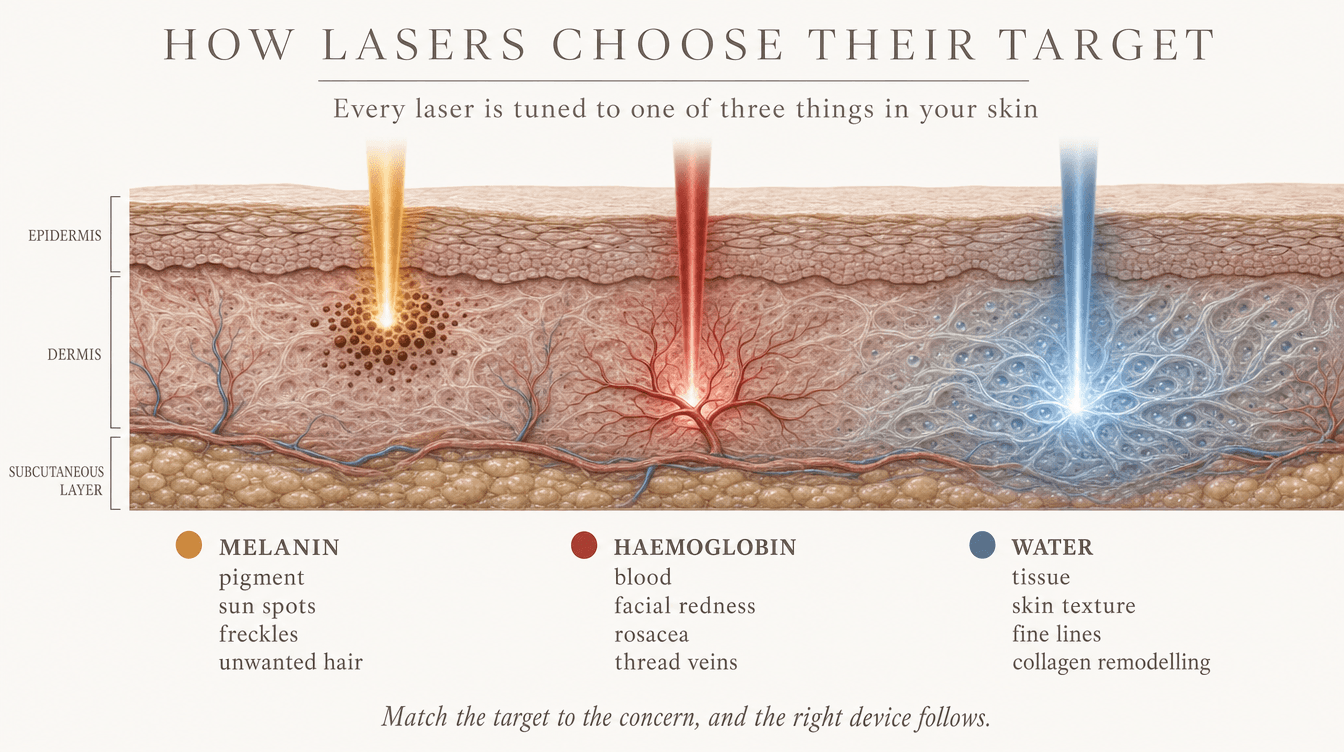
Laser skin treatments are not categorised by brand name. They are categorised by what they target. Every laser and light-based device works by delivering energy that a particular structure in your skin absorbs, and that structure, called a chromophore, determines what the treatment can change. There are three that matter in aesthetic practice: melanin (pigment), haemoglobin (blood vessels) and water (resurfacing and collagen). Understanding which one a device targets tells you far more about whether it suits your concern than the name on the machine.
Two questions will tell you almost everything you need about a device on offer. What does it target? And, for anything aimed at texture and collagen, does it remove tissue or leave the surface intact? The first question is chromophores. The second is the ablative and non-ablative distinction, and the two are independent of each other.
What is a chromophore?
A chromophore is simply a structure in the skin that absorbs light energy. When light of the right wavelength meets its matching chromophore, the energy is absorbed and converted to heat, and that heat is what produces the clinical effect.
This is the basis of *selective photothermolysis*, described by R. Rox Anderson and John Parrish in a 1983 paper in *Science* that underpins essentially all modern laser dermatology. Their insight was that precise aiming is unnecessary: if you choose a wavelength that a target absorbs more strongly than its surroundings, the target's own optical and thermal properties provide the selectivity. They demonstrated selective damage to cutaneous microvessels at 577 nm and to melanosomes within melanocytes at 351 nm.
The three principal chromophores absorb quite differently:
- Melanin absorbs broadly across the ultraviolet and visible spectrum, with absorption falling as wavelength rises.
- Haemoglobin has major absorption peaks at 418, 542 and 577 nm, which is why the 577–595 nm range is favoured for vascular work.
- Water absorbs strongly in the infrared, which is what makes resurfacing possible.
Wavelength is only half the story
Here is the part most short explainers leave out. Wavelength determines *which* chromophore absorbs the energy. Pulse duration determines whether the heat stays where you put it.
Selective photothermolysis requires three conditions together: a wavelength preferentially absorbed by the target, an exposure time no longer than the time the target takes to cool, and enough energy to affect it.
That cooling time is the target's thermal relaxation time, and it is proportional to the square of the target's diameter. Small targets shed heat quickly and need very short pulses; larger targets tolerate longer ones. If the pulse runs longer than the thermal relaxation time, heat diffuses out of the target into surrounding tissue, which is where unwanted burns, pigment change and scarring come from.
Two devices can emit the identical wavelength and do completely different jobs, purely because of pulse duration.
The clearest example is the Nd:YAG laser at 1064 nm. In Q-switched mode, firing pulses around 10 nanoseconds, it shatters pigment particles and is used for pigmented lesions and tattoo ink; it also produces a frequency-doubled 532 nm beam for superficial lesions. In long-pulsed mode, with pulses in the tens of milliseconds, the same 1064 nm wavelength is used for vascular lesions and hair removal. Same crystal, same wavelength, different chromophore in practice, entirely because of pulse duration.
This is worth stressing because "YAG" is often quoted online as though it means "vascular laser". It does not. YAG is a crystal host, not an indication. Er:YAG at 2940 nm is an ablative resurfacing laser that targets water, which is a third category again.
The three target groups
| Target chromophore | Typical wavelengths | Device families | Commonly used for |
|---|---|---|---|
| Melanin (pigment) | Broad visible; 532 nm, 694 nm, 755 nm, 1064 nm (short-pulsed) | Q-switched and picosecond lasers; IPL (broadband light, not a laser) | Sun-induced brown spots, freckles, some pigmented lesions, tattoo ink, hair reduction |
| Haemoglobin (vessels) | 532 nm; 577–595 nm; 1064 nm (long-pulsed) | KTP; pulsed dye laser; long-pulsed Nd:YAG | Facial redness, rosacea-associated redness, broken capillaries, facial veins |
| Water (resurfacing) | 1927 nm; 2940 nm; 10,600 nm | Non-ablative fractional; ablative Er:YAG; ablative CO2 | Fine lines, texture, acne scarring, collagen stimulation |
A note on IPL: it is intense pulsed *light*, not a laser. It emits filtered broadband light rather than a single coherent wavelength, which makes it flexible but less selective than a laser tuned to one target.
Ablative or non-ablative: the second question
Group three is where most people get lost, because "resurfacing" covers treatments that behave very differently. The word that separates them is ablative.
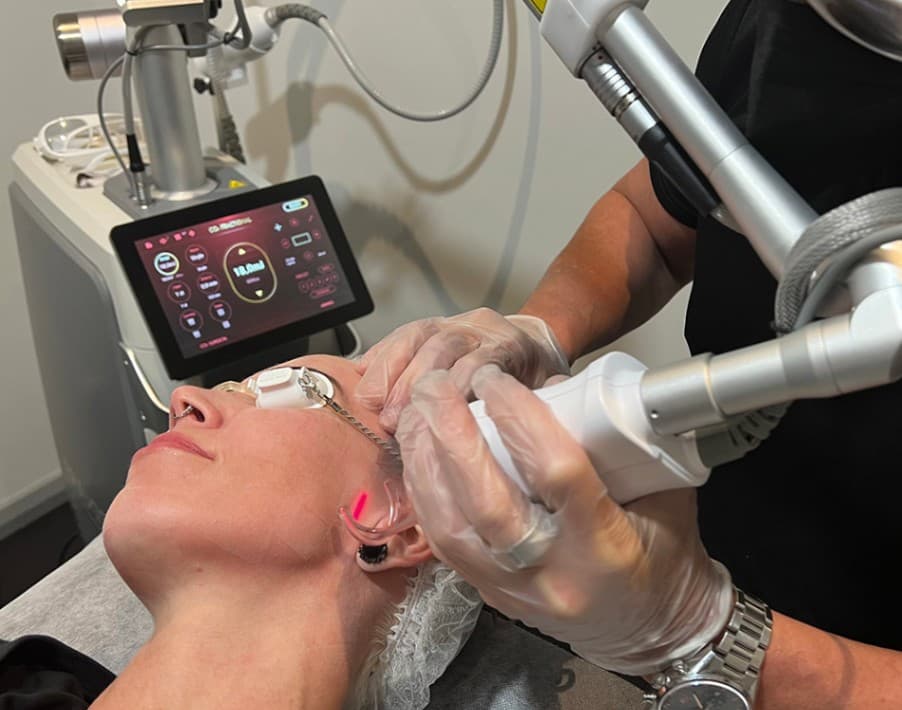
- An ablative laser vaporises and removes the surface layers of skin, including the stratum corneum. Typical wavelengths are 2940 nm (Er:YAG) and 10,600 nm (CO2).
- A non-ablative laser leaves the skin surface intact and deposits its heat in the dermis underneath, prompting collagen remodelling as the skin recovers.
The distinction is removal, not depth. This is the single most commonly garbled point about lasers.
It is worth being precise here, because the popular shorthand is that ablative lasers "go deeper" and non-ablative ones "don't go as deep". That is not what separates them. Non-ablative lasers absolutely reach the dermis - that is the entire point of them; commonly used non-ablative devices at 1550 nm are documented depositing energy close to a millimetre into the skin while leaving the surface unbroken. What changes is whether tissue is removed on the way.
That difference is what drives the practical trade-off. Removing tissue produces more change per session and needs fewer sessions, but it creates an open wound that must heal, so there is real downtime and a real infection and scarring risk. Leaving the surface intact means little or no downtime and a lower risk profile, at the cost of more sessions and more gradual change. Neither is the better choice in the abstract; they suit different concerns, different skin and different tolerances for recovery time.
Where "fractional" fits in
Fractional is a third, independent idea, and it is frequently mistaken for a synonym for ablative.
A fractional device does not treat the whole surface. It delivers energy as a grid of microscopic columns - microthermal treatment zones - with untreated skin left in between, and that untreated skin is what lets the area heal quickly. The concept was introduced by Manstein and colleagues in a 2004 paper in *Lasers in Surgery and Medicine*; in the original work a typical treatment zone was 100 µm across and 300 µm deep, with columns spaced 250 µm or more apart.
Crucially, fractional combines with either mode:
| Treats the whole surface | Fractional (columns) | |
|---|---|---|
| Ablative (removes tissue) | Traditional full-field CO2 or Er:YAG resurfacing | Ablative fractional - 2940 nm, 10,600 nm |
| Non-ablative (surface intact) | Non-ablative rejuvenation, e.g. 1064 nm, 1320 nm | Non-ablative fractional - 1550 nm, 1927 nm |
So "fractional CO2" is ablative *and* fractional. A 1550 nm fractional device is fractional and *not* ablative. Asking only "is it fractional?" tells you nothing about whether your skin will be broken.
Because only part of the surface is treated in each pass, a course is normally needed, and the proportion treated per session is a setting the practitioner chooses rather than a fixed property of the machine. Lower coverage is deliberately used in deeper skin tones to reduce the risk of post-inflammatory hyperpigmentation, which is the subject of the next section.
Why skin type changes the calculation
Melanin absorbs across a wide spectrum, which creates an unavoidable tension: in darker or recently tanned skin, the melanin in the surrounding epidermis competes with the intended target for the energy. That competing absorption is the mechanism behind most pigment-related laser complications.
In Fitzpatrick phototypes III–VI, melanocytes are more numerous and more reactive, so heat and inflammation prompt more melanin production and raise the likelihood of post-inflammatory hyperpigmentation (PIH). DermNet NZ advises extreme caution in tanned or darker-skinned patients, because the laser can destroy melanin and leave white patches (leukoderma).
Melasma deserves separate mention. Melasma is driven by inflammation and heat, which means heat-generating treatments can make it worse rather than better. Ablative resurfacing can trigger a rebound flare, and IPL is a recognised precipitator of PIH; it is not considered a first-line treatment for melasma, and results are rarely sustained. For melasma in Fitzpatrick IV–V skin, low-fluence multi-pass protocols and picosecond devices are generally preferred over IPL or ablative resurfacing. This is a decision for an experienced practitioner who has assessed your skin in person, not something to select from a menu.
What results can you realistically expect?
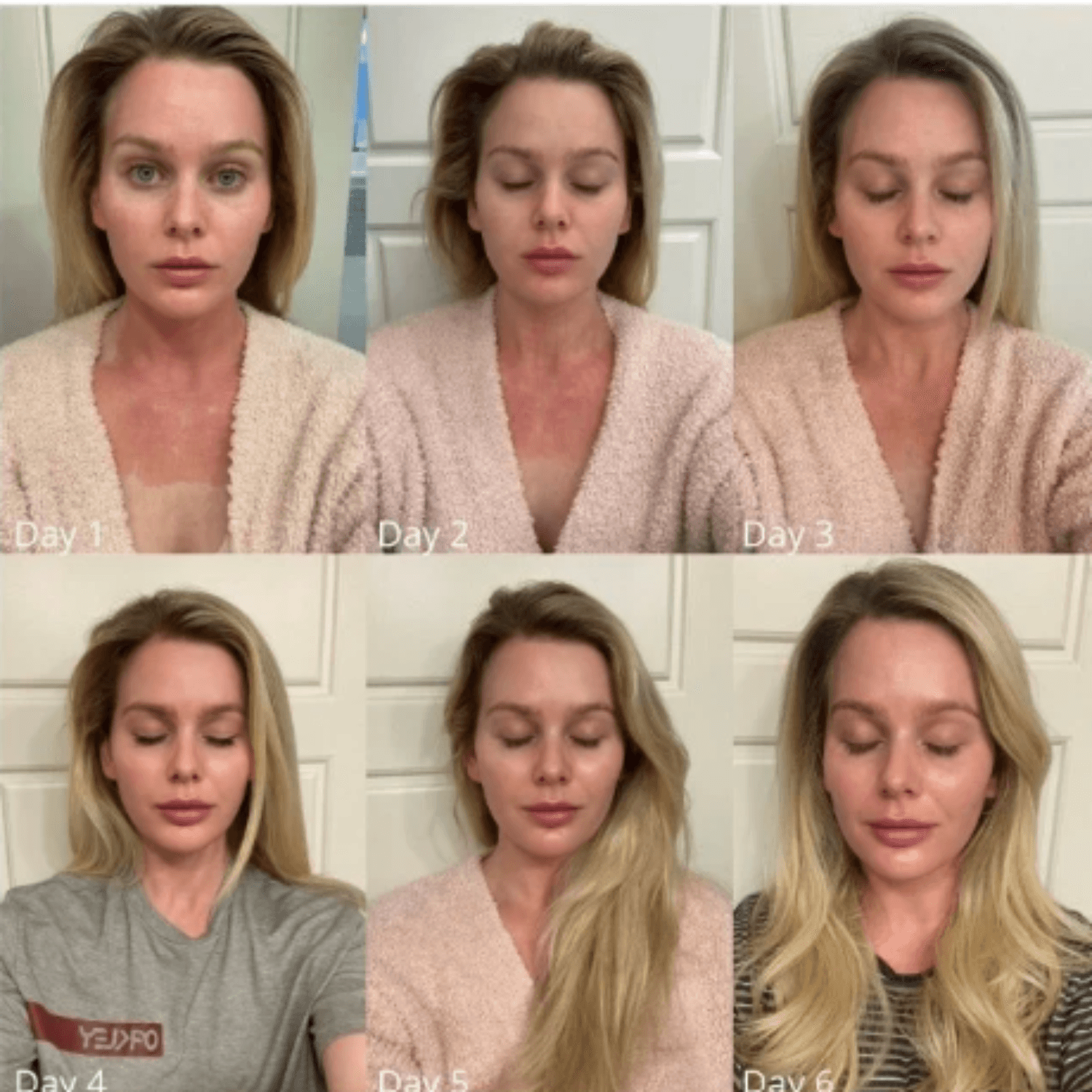
Results vary substantially between individuals, devices, settings and the number of sessions, and no reputable practitioner can promise you a specific outcome. Most pigment and vascular treatments are courses rather than single sessions. Resurfacing sits on a spectrum from non-ablative treatments with modest change and little downtime, through to ablative treatments with more visible change and a genuine recovery period.
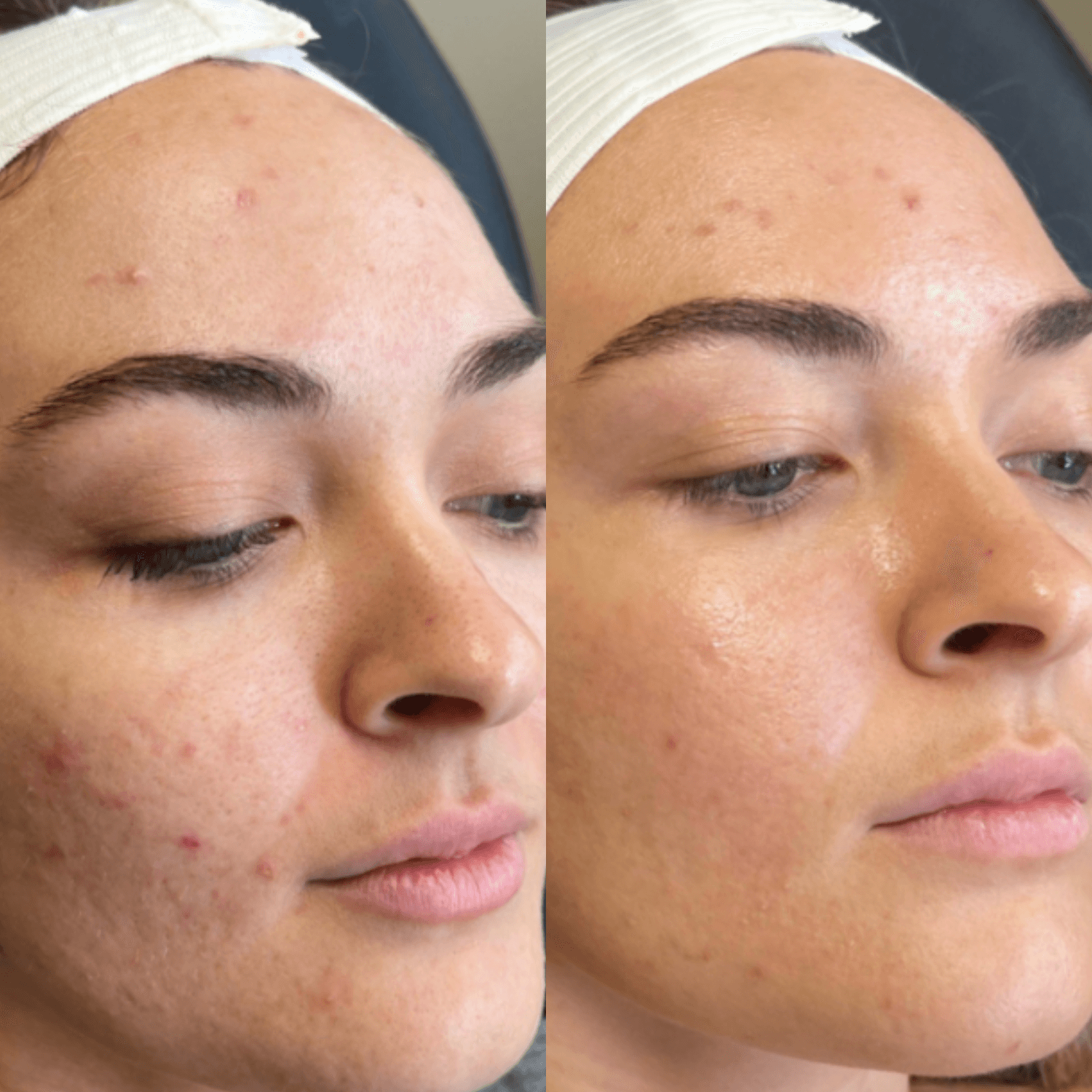
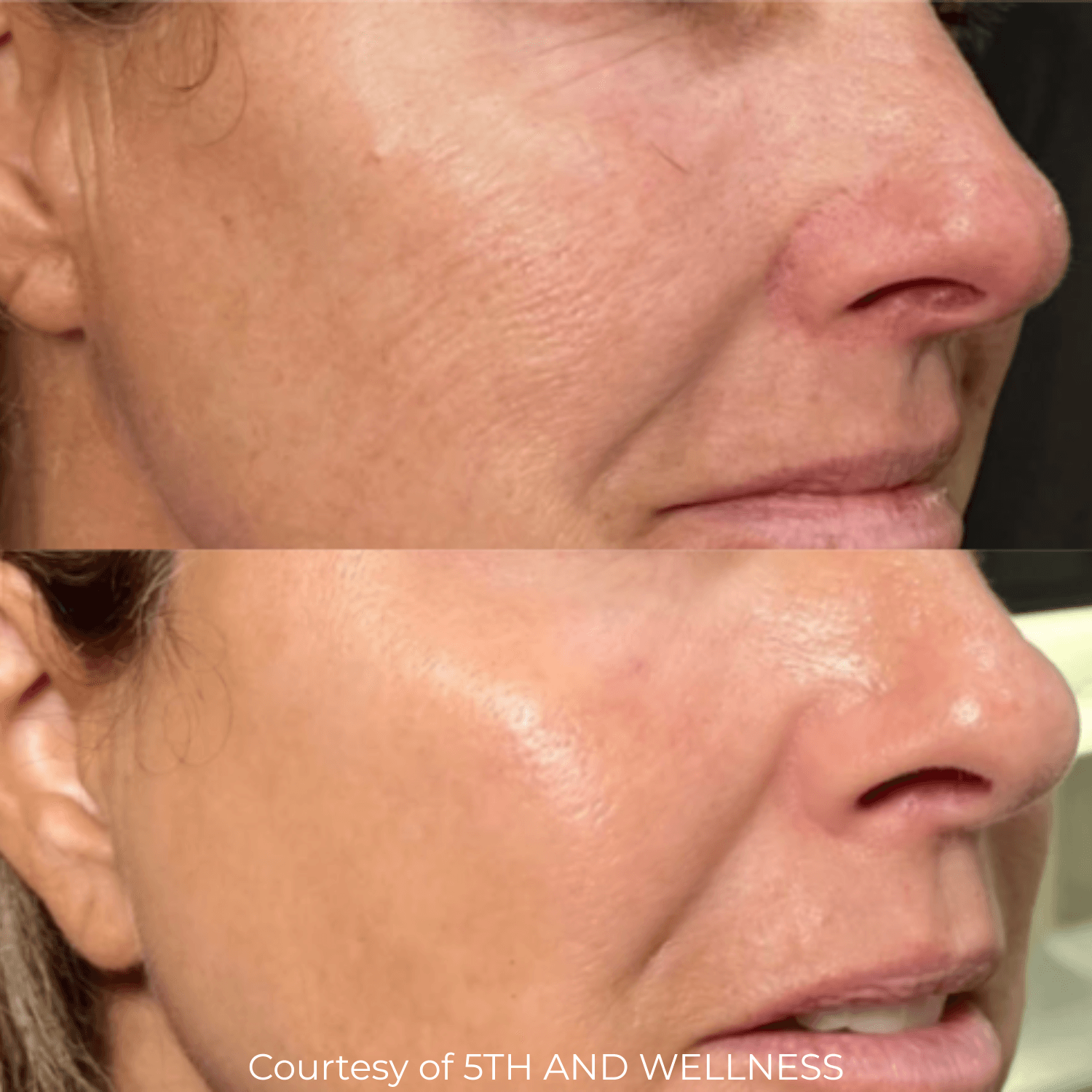
Treat online photographs sceptically. They are taken under lighting and conditions you cannot verify, they show selected individuals, and they tell you nothing about how your skin will respond.
Risks, side effects and downtime
Laser and light treatments are medical procedures with real risks. Depending on the device and settings, these can include:
- burns and blistering;
- hyperpigmentation (darkening) or hypopigmentation/leukoderma (loss of pigment), which may be long-lasting;
- scarring, including hypertrophic scarring;
- prolonged redness and swelling;
- infection, and reactivation of cold sores after resurfacing;
- eye injury without correct protective eyewear for both you and the operator;
- worsening of melasma.
Downtime ranges from none to hours of redness for gentler non-ablative and vascular treatments, up to a week or more of visible healing after ablative resurfacing. Sun avoidance and diligent sun protection afterwards are not optional; sun exposure on treated skin is a direct route to pigment complications.
Who should wait, and who should get assessed first
Discuss your history in full with a practitioner before booking if any of the following apply:
- you have a recent tan or upcoming sun exposure;
- you have melasma or a history of post-inflammatory hyperpigmentation;
- you have Fitzpatrick IV–VI skin and are being offered IPL or ablative resurfacing;
- you have a history of keloid or hypertrophic scarring;
- you have an active skin infection, or a tendency to cold sores in the treatment area;
- you are taking photosensitising medication, or have recently used oral isotretinoin;
- you are pregnant or breastfeeding;
- you have an autoimmune or photosensitive condition.
Suitability, realistic outcomes and risk can only be established by an AHPRA-registered practitioner assessing your skin in person. A patch test is a reasonable request, particularly in deeper skin tones.
How are laser skin treatments regulated in Australia?
There is no single national laser licence in Australia, and the rules differ by state and territory.
- Queensland and Tasmania regulate cosmetic lasers as radiation-emitting devices and require a specific use licence. In Queensland, a possession licence is required to own Class 4 laser apparatus, and operators must hold a use licence involving a laser safety certificate, infection prevention and control certificate, and supervised practical hours.
- New South Wales and Victoria have no state-level licence, although operators are expected to be extensively trained.
- IPL devices currently have no specific possession or use licensing requirement.
It is also worth knowing that a device used purely for cosmetic purposes is not necessarily TGA-approved, because a cosmetic application is not treated as a medical one. General guidance for consumers is published by ARPANSA, the Australian radiation protection authority.
What do laser skin treatments cost, and how do you choose a clinic?
Costs vary widely by state, device, treatment area and the number of sessions in a course, so treat any single advertised figure with caution and confirm what a quoted price actually includes: the consultation, patch testing, the number of sessions, and review appointments.
Better questions than "which laser do you have?":
- What chromophore are we targeting for my concern, and why?
- What wavelength and pulse duration will you use, and why those?
- Is this ablative or non-ablative, is it fractional, and what downtime does that mean for me?
- What is my Fitzpatrick type, and how does that change your settings?
- Will you patch test first?
- What are the realistic risks for my skin, and how are complications managed?
- Who operates the device, what is their training, and are they licensed if my state requires it?
A practitioner who answers these clearly is telling you more about the quality of your likely outcome than any brand name on the machine.
GeelongShow on map
96 Gheringhap Street, Geelong VIC 3220, Australia
NorthbridgeShow on map
296 Sailors Bay Road, Northbridge NSW 2063, Australia

KewShow on map
181 High Street, Kew VIC 3101, Australia
KewShow on map
181 High Street, Kew VIC 3101, Australia
DarlinghurstShow on map
177 Oxford St, Darlinghurst New South Wales 2010, Australia
GeelongShow on map
96 Gheringhap Street, Geelong VIC 3220, Australia
HamptonShow on map
425a Hampton Street, Hampton VIC 3188, Australia
HamptonShow on map
425a Hampton Street, Hampton VIC 3188, Australia
HamptonShow on map
425a Hampton Street, Hampton VIC 3188, Australia
AnnerleyShow on map
641 Ipswich Rd, Annerley Queensland 4103, Australia
Frequently asked questions
Is a more expensive or better-known laser brand a better treatment? Not necessarily. What matters clinically is the wavelength, the pulse duration, the settings chosen for your skin, and the skill of the operator. A well-matched device used carefully by an experienced practitioner is more relevant to your outcome than the brand name.
What is the difference between IPL and a laser? IPL emits filtered broadband light across a range of wavelengths, while a laser emits a single coherent wavelength. That makes IPL versatile but less selective. IPL is commonly used for pigment and redness, but it carries a higher risk of post-inflammatory hyperpigmentation in deeper skin tones.
What is the difference between an ablative and a non-ablative laser? An ablative laser vaporises and removes the surface layers of skin, while a non-ablative laser leaves the surface intact and heats the dermis underneath. The difference is whether tissue is removed, not how deep the energy travels - non-ablative lasers do reach the dermis. Ablative treatments generally achieve more per session and need fewer of them, but involve genuine downtime and a higher risk of infection, pigment change and scarring.
Does fractional mean the same thing as ablative? No. Fractional describes how the energy is delivered: as a grid of microscopic columns with untreated skin between them, which is what allows faster healing. It is independent of whether a laser is ablative. Fractional CO2 is both ablative and fractional, while a 1550 nm fractional device is fractional but not ablative and leaves your skin surface unbroken.
Can laser treatment fix my melasma? Melasma is difficult to treat and is driven by heat and inflammation, so some devices can worsen it. IPL and ablative resurfacing are not first-line options, and results from laser treatment are often not sustained. Melasma management usually combines several approaches and needs an experienced practitioner.
Are laser treatments safe for darker skin tones? Some are, with the right wavelength, conservative settings and an experienced operator, but risk is genuinely higher. Melanin in the surrounding skin competes for the energy, raising the chance of hyperpigmentation or loss of pigment. Ask about your Fitzpatrick type, request a patch test, and be cautious about IPL.
Why do I need multiple sessions? Selective photothermolysis affects only what absorbs the energy during each pulse, and biological targets are not all available at once. Hair, for example, is only susceptible during part of its growth cycle. Courses are spaced to work with that and to keep each session's energy within a safe range.
Does a laser treatment hurt? Sensation varies by device and area, and is commonly described as a hot snapping feeling. Cooling, topical anaesthetic and adjusted settings are used to manage it. Ablative resurfacing is more uncomfortable and requires more preparation than gentler non-ablative treatments.
Frequently asked questions
Is a more expensive or better-known laser brand a better treatment?
Not necessarily. What matters clinically is the wavelength, the pulse duration, the settings chosen for your skin, and the skill of the operator. A well-matched device used carefully by an experienced practitioner is more relevant to your outcome than the brand name.
What is the difference between IPL and a laser?
IPL emits filtered broadband light across a range of wavelengths, while a laser emits a single coherent wavelength. That makes IPL versatile but less selective. IPL is commonly used for pigment and redness, but it carries a higher risk of post-inflammatory hyperpigmentation in deeper skin tones.
What is the difference between an ablative and a non-ablative laser?
An ablative laser vaporises and removes the surface layers of skin, while a non-ablative laser leaves the surface intact and heats the dermis underneath. The difference is whether tissue is removed, not how deep the energy travels - non-ablative lasers do reach the dermis. Ablative treatments generally achieve more per session and need fewer of them, but involve genuine downtime and a higher risk of infection, pigment change and scarring.
Does fractional mean the same thing as ablative?
No. Fractional describes how the energy is delivered: as a grid of microscopic columns with untreated skin between them, which is what allows faster healing. It is independent of whether a laser is ablative. Fractional CO2 is both ablative and fractional, while a 1550 nm fractional device is fractional but not ablative and leaves your skin surface unbroken.
Can laser treatment fix my melasma?
Melasma is difficult to treat and is driven by heat and inflammation, so some devices can worsen it. IPL and ablative resurfacing are not first-line options, and results from laser treatment are often not sustained. Melasma management usually combines several approaches and needs an experienced practitioner.
Are laser treatments safe for darker skin tones?
Some are, with the right wavelength, conservative settings and an experienced operator, but risk is genuinely higher. Melanin in the surrounding skin competes for the energy, raising the chance of hyperpigmentation or loss of pigment. Ask about your Fitzpatrick type, request a patch test, and be cautious about IPL.
Why do I need multiple sessions?
Selective photothermolysis affects only what absorbs the energy during each pulse, and biological targets are not all available at once. Hair, for example, is only susceptible during part of its growth cycle. Courses are spaced to work with that and to keep each session's energy within a safe range.
Does a laser treatment hurt?
Sensation varies by device and area, and is commonly described as a hot snapping feeling. Cooling, topical anaesthetic and adjusted settings are used to manage it. Ablative resurfacing is more uncomfortable and requires more preparation than gentler non-ablative treatments.
Ready to book?
Find a clinicRelated reading
Devices & Technology
How FABshaping.com Is Connecting Consumers, Clinics And Technology
FABshaping.com lets consumers start from their concern rather than a device name, then shows them the clinics that offer the treatment. For practices, that is visibility at the exact moment someone is deciding what to book — and where.
21 SEPTEMBER 2026
Choosing a Clinic
How to Choose a Cosmetic Clinic in Australia
Choosing a cosmetic clinic is an important decision. This guide explains what to look for in a cosmetic clinic in Australia, which questions to ask and how FABshaping can help you explore treatments and clinics with greater confidence.
28 SEPTEMBER 2026
Spa + Clinic Publishes about FABshaping.com as Australia's New Aesthetic Booking Platform
If you've ever spent the first half of a consultation explaining the difference between HIFU and radiofrequency, or answering "does Morpheus8 hurt?" before you've even said hello - you're going to love what's coming.
15 SEPTEMBER 2026